
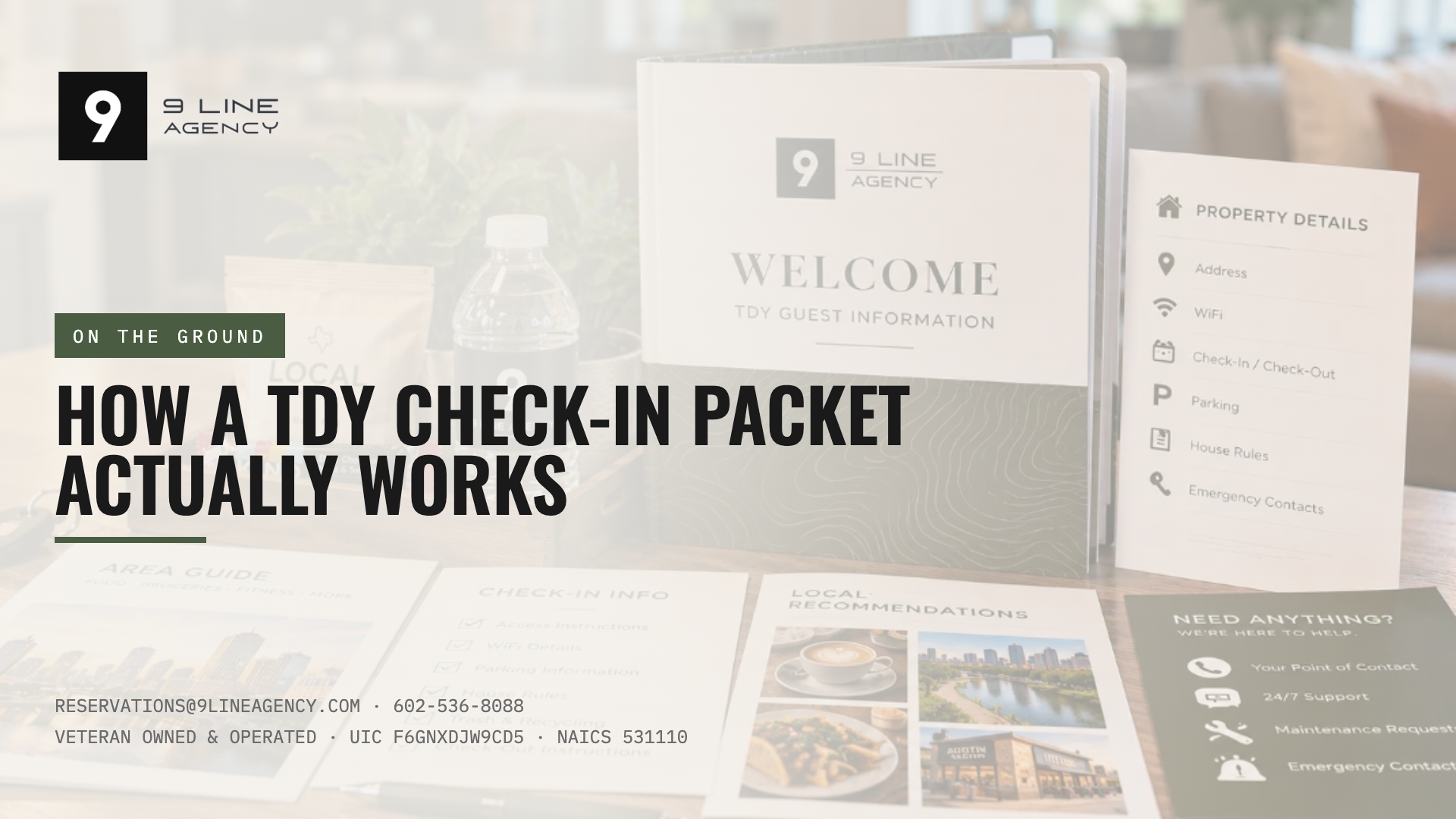
How a TDY Check-In Packet Actually Works
A hotel hands you a key packet and a room number. A house needs more than that.
Residential TDY fails when 12 people land and nobody knows which bedroom is theirs, what the code is, or who to text when the lock does not open. That is not a property problem. That is a packet problem.
9 Line Agency builds a check-in packet with the planner before anyone boards. This is what is in it, who sees what, and how to use it so the first 30 minutes of the TDY are controlled instead of chaotic.
If you have never stayed in a house on official travel, read this before you send the team.
Why a house needs a packet and a hotel does not
A hotel has a front desk. Someone will tell you the room even if your orders are late. Housekeeping has a master key. The ice machine is in the hall.
A single-family house has none of that. The door code is the front desk. The assigned bedroom is the key packet. The planner and 9 Line Agency are the night manager.
If those pieces live in a group chat instead of a packet, you get driveway negotiations and three people claiming the same room. Leadership hears about that. The next approval gets harder.
The packet is how residential lodging stays official.
What the packet contains
A usable packet is short. It is not a novel. It is the minimum data every traveler needs to get inside and stay inside the standard.
Access
- Property address
- Door or lockbox code
- Garage code if there is one
- Gate or community code if the neighborhood uses one
- Backup method if the primary code fails
Assignment
- Which house they are in if the movement has more than one
- Which bedroom is theirs
- Who else is in that house
- Primary bathroom if the layout requires it
Live-in details
- Wi-Fi name and password
- Parking rule
- Trash day
- Kitchen standard
- Quiet hours / neighbor reality
- What is off limits (owner closets, extra guests)
Support
- Who they text at 2300 (planner first, then 9 Line Agency)
- What counts as an emergency versus a comfort issue
- How to report missing cookware, dead AC, or a bad lock
That is the whole packet. If a line is missing, someone will invent it on arrival.
What the traveler sees vs what the planner sees
Travelers do not need every house on the trip.
Each traveler gets:
- Their address
- Their codes
- Their bedroom
- House rules
- Support contacts
The planner gets:
- Full roster mapped to house and bedroom
- Codes for every property
- Arrival windows
- Vehicle assignments if houses are cutting rental cars
- A single view of the footprint
9 Line Agency builds both layers from the same manifest. The planner can dispatch instructions as people fly in. Nobody needs to crowdsource Wi-Fi in a group text.
Do not send house three’s codes to the entire 25-person list. Need to know still applies off the installation.
How assignments get made
We do not let the team pick rooms in the driveway.
During planning, the main planner and our team assign every traveler to a bedroom. That assignment goes into the check-in instructions. Cadre, evaluators, and anyone who cannot share are protected first if the plan calls for it. Density only happens when the budget required it and the planner already agreed.
If the roster changes before wheels down, the planner updates the packet. Individuals do not reshuffle.
If arrivals are staggered, the first team in does not claim extra rooms “until the others show up.” Empty assigned rooms stay empty.
Arrival day using the packet
Brief this sequence. Put it on the first page.
- Land
- Move to the assigned house, or to the gathering house if that is the reception plan
- Unload in the garage or out of sight
- Use the code in the packet
- Walk to the assigned bedroom
- Two-minute check: water, AC, Wi-Fi, kitchen basics
- Report problems the same hour
If the code fails, they do not kick a door and they do not start a fight with a host app. They call the process.
For large movements, a gathering house can be the reception node. People arrive there, get the rental plan, and drive to the assigned property. That path belongs in the packet too.
What the packet is not
It is not a lease in a traveler’s name.
It is not a consumer booking confirmation with a host photo.
It is not permission to move furniture, change locks, or invite extra people.
The house is official lodging. The packet is the operating instruction for that lodging.
When the packet saves the stay
The lock fails at night. The packet has a backup and a phone number.
Two flights land four hours apart. The first group already knows they do not take the empty rooms.
Someone packed comms gear. The packet told them which house has the garage and the yard.
A student washes out. The planner already knows which bedroom comes off the roster.
None of that works if the only “packet” is a screenshot in a group chat from last week.
How this ties to JTR and DTS
The packet does not replace invoices, memos, or line codes. It supports them.
Official travel needs a repeatable process: who stayed where, who authorized it, how the bill is structured. Bedroom-level assignment is part of that record. It also keeps a service member off a personal consumer lease in someone else’s name.
If your finance shop asks “who was in which property,” the planner should be able to answer from the same manifest that built the packets.
What to put in the trip request so we can build the packet
We cannot assign rooms to a blank roster.
Send:
- Location and dates
- Headcount range
- One bedroom per person yes or no
- Names or duty positions if assignments matter (cadre vs students)
- Elements that must be separated
- Staggered arrival times if you know them
- Gathering-house need
- Vehicle plan if houses should cut cars
Complete intake produces packets. Incomplete intake produces “we will figure it out on the ground.” That is a hotel habit. It does not belong in a house.
How to brief the packet before wheels down
Read this out loud.
“You are not checking into a hotel. Your packet is your room assignment and your front desk. We are not picking rooms in the driveway.
Unload out of sight. Gear does not live in the living room. If something is broken, report it the same day. Do not argue with a host.
Living room is team space. Bedroom is yours. Treat the house so we can use houses again.”
Then make them open the packet once before they travel. The first time they see the code should not be at the door in the dark.
After they are in
First night: five-minute check. Right rooms. Codes worked. Kitchen usable.
End of TDY: note what was missing from the packet. That note is how the next movement gets cleaner.
9 Line Agency stands behind the property. If the house is wrong, we move the team. The packet is still required. A perfect house with no assignments is still a messy arrival.
The Thursday brief
If your shop has never run a residential TDY, the packet is the part that makes it feel operational instead of experimental.
We walk through this on the weekly Thursday brief: what planners get, what travelers get, and how to send a trip request that produces usable COAs and usable packets.
Follow us on Instagram to get the weekly link and register for our briefs.
If you already have dates and a roster, send the trip request at www.9lineagency.com. We will build the plan so check-in is a process, not a scramble.
Back to Blog